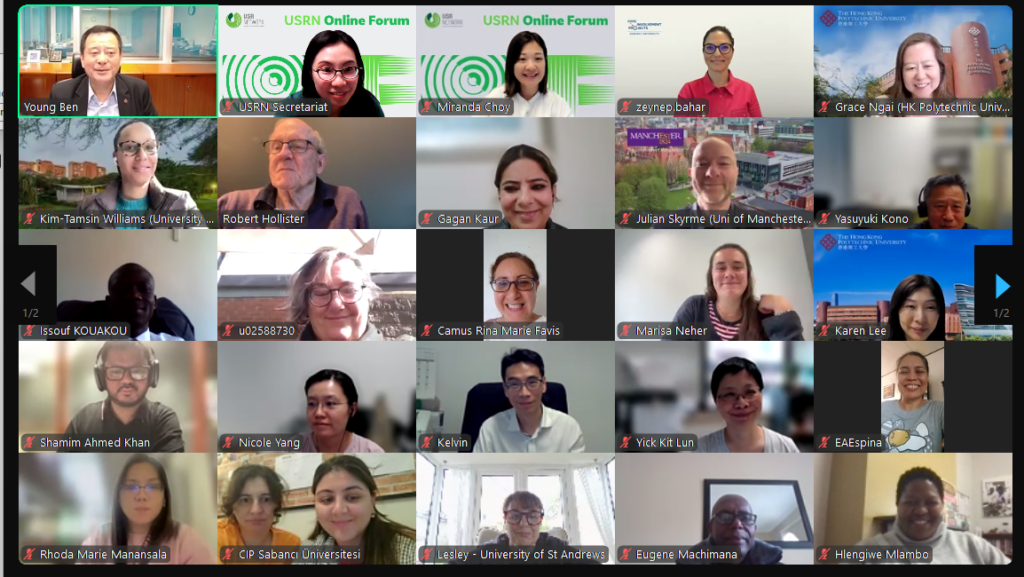
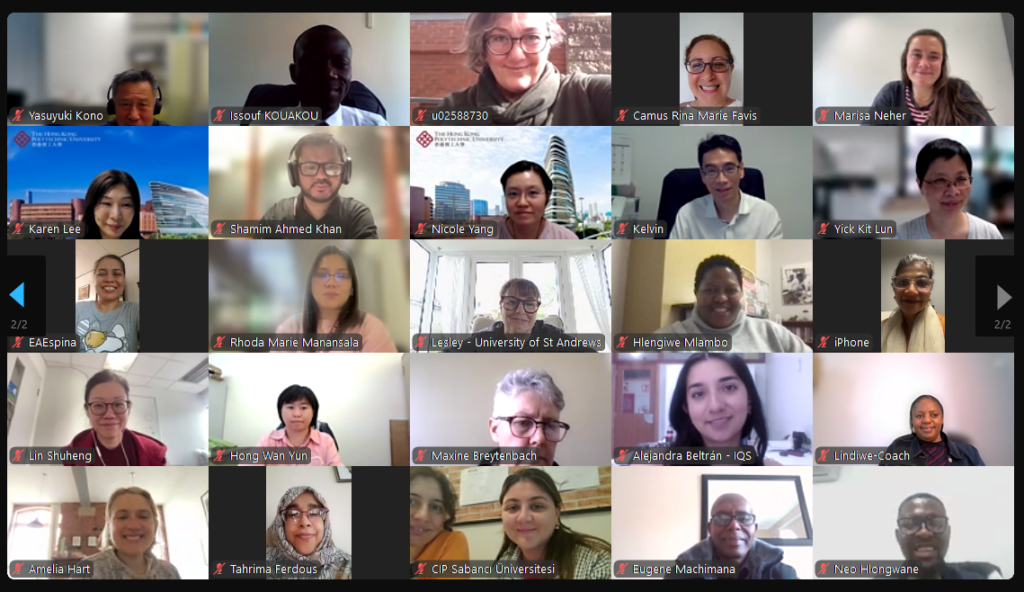
In collaboration with The Hong Kong Polytechnic University (PolyU), the 8th USRN Online Forum, themed “Engaging, Selecting, and Supporting Students in University Social Responsibility and Volunteering Programs: Criteria, Processes, and Evaluations”, was successfully held on 9 June 2026. With close to 200 registrants from PolyU, USRN member institutions and universities around the world, the forum provided a valuable platform for colleagues in higher education to exchange insights and good practices on designing meaningful, inclusive and impactful community engagement opportunities for students.
The forum was also presented as the 4th EVOLVE Salon: Global Engagement and Student Development at PolyU. Moderated by Professor Ben Young, Chair of the USRN Executive Committee and Vice President (Student and Global Affairs) at PolyU, the session featured three speakers: Ms Zeynep Bahar, Civic Involvement Projects Manager at Sabanci University; Mrs Kim-Tamsin Williams, Lecturer, Sports Management and Human Movement Studies at the University of Pretoria; and Professor Grace Ngai, Head, Service-Learning and Leadership Office at The Hong Kong Polytechnic University.
Professor Ben Young opened the forum by welcoming participants from different regions and highlighting the importance of the theme. He noted that universities often face common challenges in developing social responsibility and volunteering programmes, including how to engage and motivate diverse student groups, ensure fair and transparent selection process, and evaluate programmes in ways that enhance quality while supporting student development. He also introduced USRN as a global network of universities committed to advancing university social responsibility through collaboration, innovation and collective action.
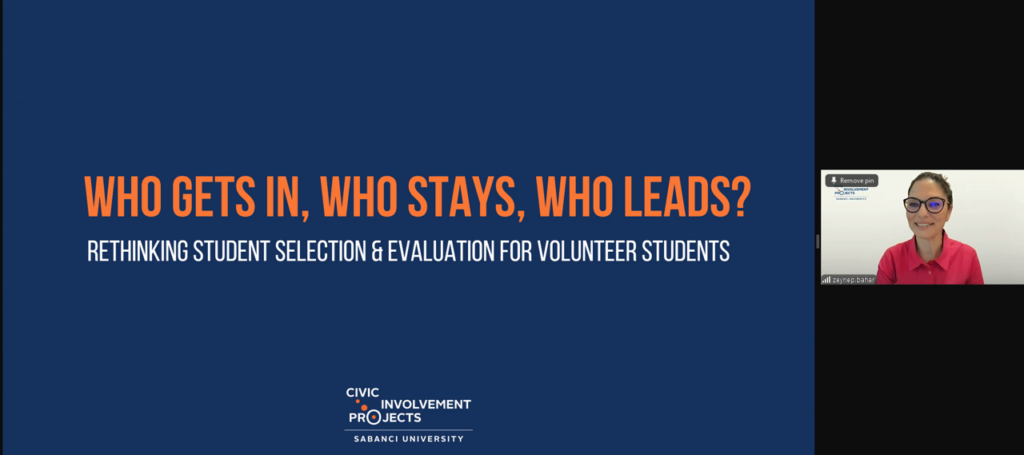
Ms Zeynep Bahar shared the experience of the Sabanci University’s Civic Involvement Projects (CIP), a mandatory first-year course established in 1999 to foster socially responsible citizens through experiential learning. Through the course, students address real-life social issues in partnership with communities. A distinctive feature of the CIP is its student leadership structure, in which supervisors and peer leaders take on important facilitation roles and serve as role models for other students. Selection for these roles is based on a multi-level assessment of students’ motivation, leadership potential, communication skills, and alignment with CIP values, rather than academic performance alone. This approach helps identify students who can effectively support the learning of others while developing their own leadership abilities. Ms Bahar also emphasised that student engagement is strengthened through a strong sense of community and accountability, reinforced by recognition practices.
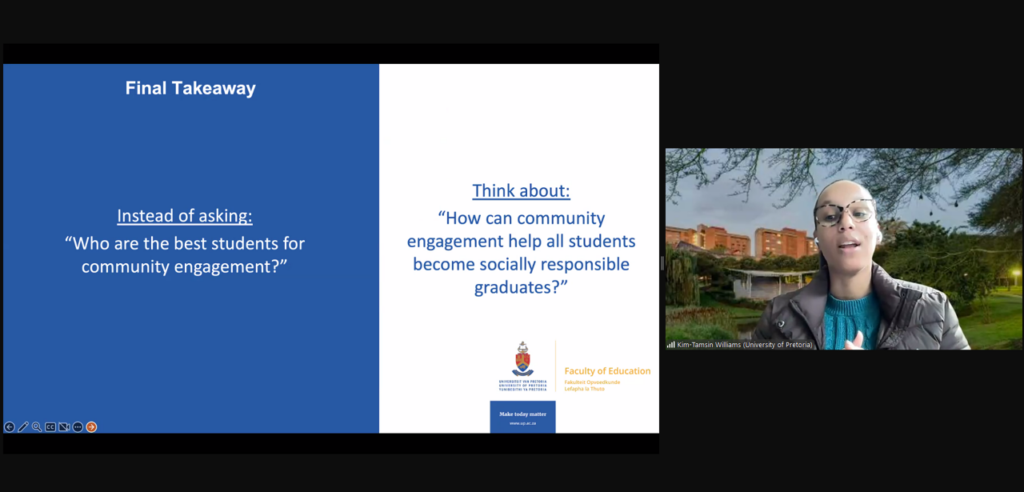
Mrs Kim-Tamsin Williams presented a practical example of curricular community engagement within a motor development module in the Faculty of Education at the University of Pretoria. She encouraged participants to shift the focus from asking “Who should participate?” to “How can participation become a learning opportunity for all?” By integrating the University of Pretoria’s Curricular Community Engagement Framework, she demonstrated how community engagement can be embedded in teaching and learning and aligned with module outcomes. Involving over 250 students, the initiative treats engagement not as an extra activity but as an integral part of the curriculum, following a structured learning cycle of preparation, engagement, and consolidation. Mrs Williams highlighted that assessment should concentrate on students’ preparation, participation, application, reflection, and sense of citizenship, with community partners contributing feedback on student performance, making evaluation a developmental process rather than simply a gatekeeping mechanism.
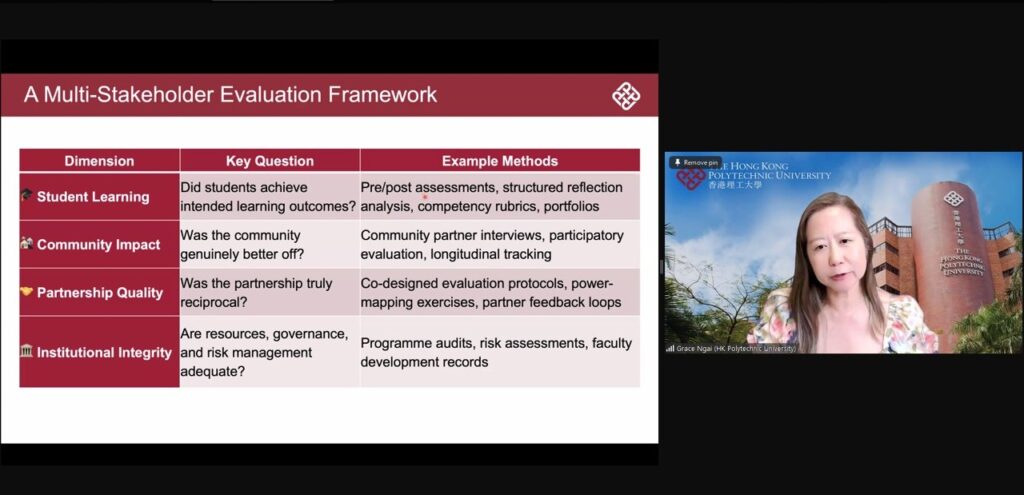
Professor Grace Ngai addressed a critical question of whether universities can ensure that students are genuinely learning through service-learning. While many institutions believe in the transformative power of service-learning, she stressed that belief alone is not enough. Universities, she argued, have an ethical obligation to rigorously evaluate the benefits to students, communities, partners, and institutions. Professor Ngai noted that many service-learning programmes tend to measure outputs such as student satisfaction, service hours, and participant numbers. While useful for reporting purposes, such indicators do not adequately demonstrate actual learning or community benefit. She advocated for a broader ethical evaluation framework encompassing student learning, community impact, partnership quality, and institutional integrity. Drawing on PolyU’s experience of offering more than 70 service-learning subjects and engaging nearly 5,000 students annually, Professor Ngai shared how service-learning evaluation is embedded within the University’s quality assurance structure, including quality vetting and risk assessment. Her findings suggest that, when implemented effectively, mandatory service-learning can bring substantial benefits to students, and that high-quality service-learning experiences can significantly influence future civic engagement, especially among students who may initially be less inclined to service. She also encouraged institutions to co-design evaluations with community partners, develop culturally grounded assessment tools, share insights across institutions, and enhance the evaluative capacity of faculty members and institutions.
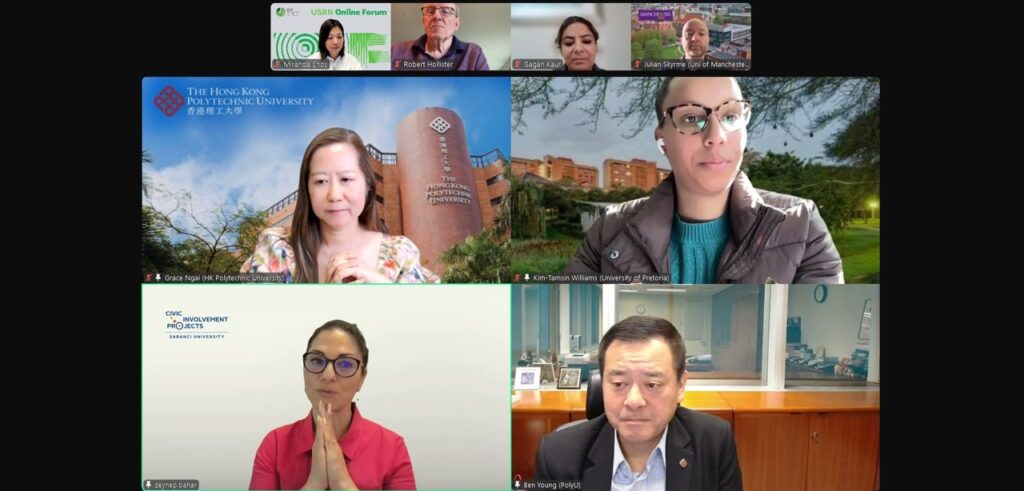
The forum concluded with an engaging discussion on practical issues related to evaluation, community impact and programme sustainability. Despite differences in institutional contexts, the dialogue highlighted a common commitment among universities to nurturing students’ sense of responsibility, compassion and readiness to contribute to society. Through thoughtful programme design, inclusive participation, transparent selection processes, strong community partnerships and rigorous evaluation, higher education institutions can continue to strengthen the quality and impact of university social responsibility and volunteering initiatives.
Playback